
I do not go into the forest to find a pretty view.
A pretty view usually already knows how to be looked at. It offers itself entirely: here is the path, here are the trunks, here is the green depth, here is the sky between the crowns. In such a landscape, everything is in its place. It can be recognized, described, and stored in memory with almost no loss.
But abstract forest photography begins at the moment when ordinary recognition is no longer enough.
I step beneath the trees, and the forest gradually ceases to be a mere image. It becomes a space through which breath passes. The path leads forward, but promises no destination. The crowns converge overhead, parting where the clouds move slower than the wind. The light changes not as an event, but as a state of being. I take a step, stop, and listen to how the place responds to my presence.
A Path That Leads to No Plot
In conventional landscape photography, a path often performs a clear compositional function. It draws the eye into the frame, creates perspective, and guides attention to a distant point. This is one of the most recognizable ways to tell a story about a forest space.
I am interested in the moment when the path ceases to be a pointer. It becomes a line, a rhythm, a soft movement of color. It may no longer be read literally, but it can be felt: as the continuation of a step, as a trace left by the body in space.
This does not always require searching for a rare location. Sometimes it is enough to stop on a familiar trail and change the way you look. To look not into the distance, but underfoot. To raise the camera to the crowns. To get closer to the bark, moss, or a delicate twig. To remove from the frame everything that explains the forest too quickly.
Abstraction does not arise from the absence of reality. It arises from a more attentive contact with it. First, there is the real forest, the real air, the real surface of the earth. Then the image is freed from the obligation to name everything.
This is why abstract forest photography is neither a decorative version of a landscape nor an attempt to disguise poor focus for me. It is a way to approach what usually remains between the facts: the shift in light, the trembling of the air, the memory of a place that no longer coincides with the place itself.
When Crowns Become a Gesture
I raise the camera upward, toward the crowns. Fragments of a cloudy sky open up between the trunks. In an ordinary photograph, these elements could be separated: trees at the bottom, sky at the top. But the forest is rarely perceived as divided in this way. It is experienced by the entire body vertically, from bottom to top, from the earth to the light.
The crowns form a complex architecture. They intersect, overlap, and disappear into the gray air. The branches resemble the nervous system of the space rather than a blueprint. The clouds pass behind them, and their movement becomes almost invisible. Only the altered light reveals that the sky continues to live.
In such scenes, I am not interested in a precise description of a tree, but in its presence. A trunk can turn into a vertical trace. A branch into a short line. The light between the leaves into a patch that holds the entire composition together. The distinctness of forms weakens, while rhythm, scale, and the sense of depth intensify.
Abstract photography works with what remains when the subject ceases to be the main focus. It can be repetition, texture, color, movement, or the relationship between emptiness and density. In the forest, all of this already exists. The photographer's task is not to add expressiveness, but to notice it before it dissolves.

Breath and Camera Movement
My camera moves with me. This movement is neither a post-effect nor added to the image later. It happens at the very moment when the shutter is open, and attention holds the scene on the boundary between control and trust.
In intentional camera movement, or ICM, speed in itself is not what matters. What matters is the connection between the gesture, shutter speed, direction of gaze, and inner state. The camera can be guided upward following the trunks. It can be softly shifted along the path. It can allow movement to slightly disrupt its own certainty.
Sometimes an image emerges from a short, almost imperceptible impulse. Sometimes the camera travels a greater distance, and the forest turns into a flow of vertical or diagonal traces. The exact same patch of space can yield completely different results because what is being photographed is not just a location. What is being photographed is the encounter between the place and the body.
At this moment, breath becomes part of the process. On the inhale, space expands. On the exhale, the hand shifts, and forms begin to draw closer. This is not a mystical explanation of photography, but a simple physical fact: the image is created by human movement, exposure duration, light, and how calmly one is able to remain within the moment.
Thus, forest photography is born, in which blur does not mean a lack of information. Blur preserves a different kind of information: direction, tension, the temperature of the light, the sense of distance. It leaves room for a perception that is not obliged to jump to immediate conclusions.
Clouds That Enter the Forest
Clouds are especially important during a walk in the forest. They change more than just the sky; they change the entire color of the space.
Under a sunny sky, leaves may sound brighter, trunks more contrasting, and the path warmer. Before rain, the forest becomes dense and almost monochromatic. After rain, colors deepen, and the air becomes visible in its humid softness. A cloud passes over the crowns, and for a few seconds, the entire image acquires a different tonal quality.
I do not perceive clouds as a background. They are a mobile part of the composition, an invisible regulator of light. Thanks to them, the forest never remains the same. Even a stationary trunk turns out to be part of what is happening: the space around it changes, shades disappear and return, and the distance between the object and the gaze shifts.
In abstract forest photography, the sky can be almost unrecognizable. It dissolves in light layers, appears in gaps, and becomes a cold patch between dark lines. But it is precisely this ambiguity that holds the image together. It serves as a reminder: the forest does not end where visible form ends.
From Landscape to Inner State
Forest photography can document a route. It can report where the photographer was and what they saw. But sometimes a capture preserves not a place, but a state of mind that cannot be pointed out on a map.
I think of forest photography as the space between the external and the internal. Outside, there is the path, the trees, the clouds, and the light. Inside me, there is the pace of my steps, fatigue, attention, memory, and the desire to briefly stop explaining what is seen.
Photography connects these two layers without closing them off with a definitive meaning.
This is why my images are created in the forest rather than constructed from it after returning. I work with intentional camera movement and multiple exposure directly inside the camera. Subsequent processing is limited to color: it helps manifest the mood of a moment that has already occurred, without adding foreign objects or a new reality to the image. This approach is described in more detail on the About Oleksandr Shapovalov page.
It is important to me to preserve the physical honesty of the capture. Real light, real movement, and a real encounter with the place remain within it. Yet the photograph is not required to look realistic. Its task can be different: to return to the viewer the ability to look more slowly.
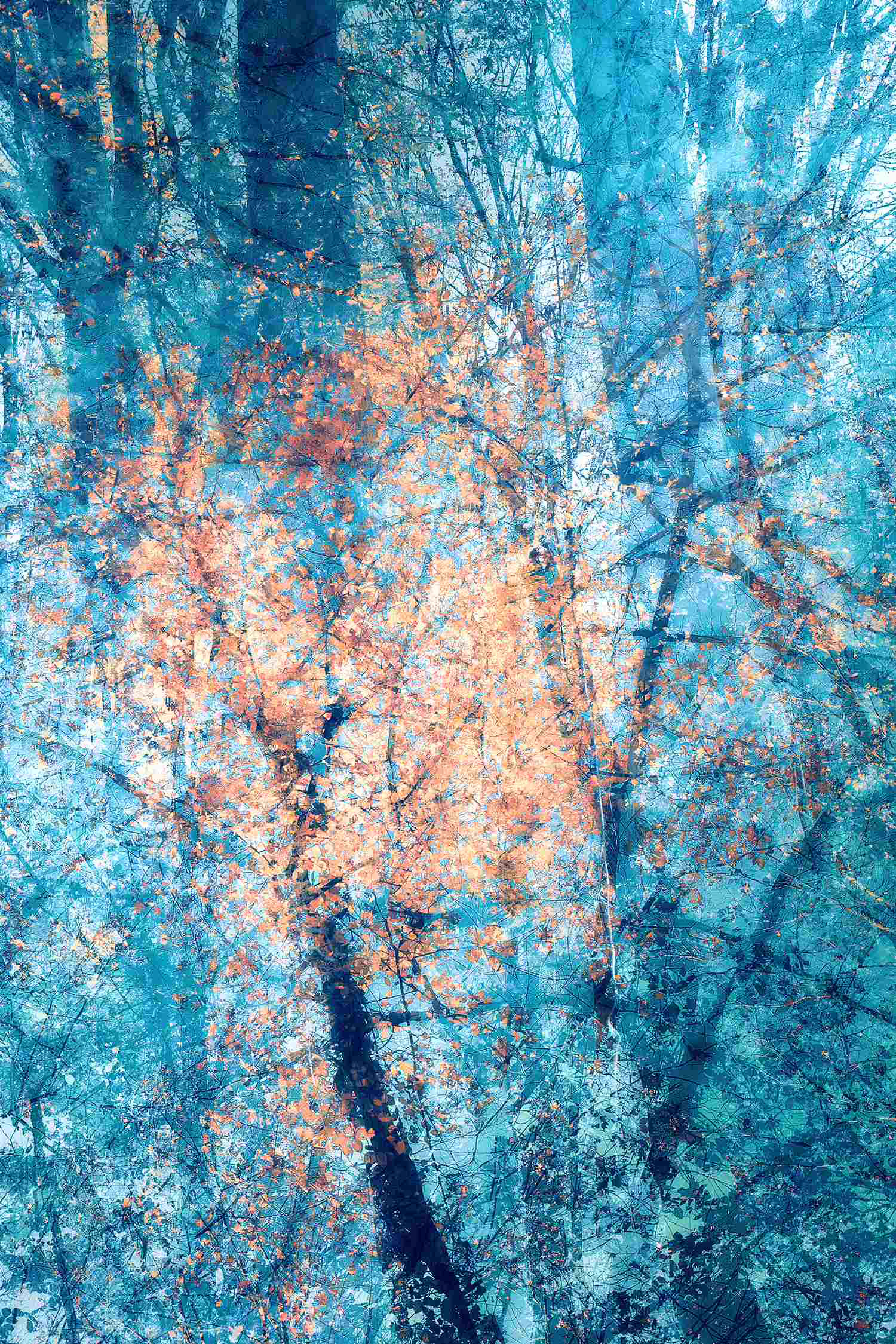
How to Look at an Abstract Forest Image
One does not have to immediately look for a tree, a path, or the sky in the image. You can start with color. Then notice the direction of movement. Next, feel where the image becomes dense and where it leaves room for a pause.
Some forms manifest gradually. First, a cold blue or deep green is visible. Then a vertical rhythm reminiscent of trunks appears. Afterwards, the gaze finds a bright window between the crowns. But the image does not have to culminate in a recognizable object. It can remain a sensation—quiet, fluid, open.
I am drawn to photography that does not demand an immediate answer. It does not ask: "What exactly is depicted?" Instead, it first offers another question: "What happens to my gaze while I am looking at this?"
In this sense, abstract forest photography becomes more than just a genre or a technique. It becomes a practice of attention. A trip into the forest begins with a desire to take a picture, but gradually turns into a return to one's own breath.
The camera helps notice what memory alone cannot hold: the light that washed over the trunks, the movement of the clouds, the soft resistance of the air, the step along the wet path.
Returning from the Forest with an Image
When I return, the forest does not end at the last tree. It continues to live in the colors preserved within the frame and in the blurred lines where form has not yet become final.
A good photograph does not always report everything that happened. Sometimes it retains only the trace of a presence. Within it remains a person who stopped on the path, raised the camera to the crowns, saw a cloud, and allowed their hand to move in time with their breath.
From this trace, an abstract image of the forest can emerge—not an illustration of nature, but its lived continuation. A space where trees become light, light becomes movement, movement becomes memory, and memory returns once again to the body.
I go into the forest for pictures. But every time, I return with something less definitive and, perhaps, more important: the feeling that for a brief moment, I managed not to look at nature from the outside, but to be inside its rhythm.
Thank you!
Fine Art Photographer Oleksandr Shapovalov based in Dortmund, Germany